
The Academy
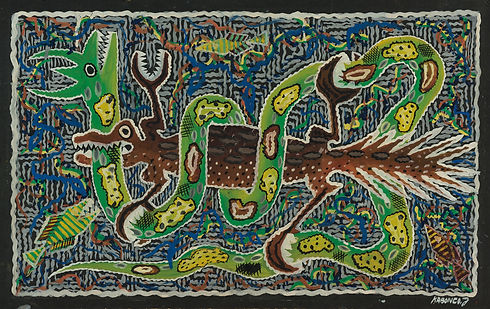
Joining the Académie des Beaux-Arts d’Elisabethville in September 1953, Kabongo was first drawn to architecture, but Moonens steered him towards fine arts after recognising his artistic talent. After three years of training, he was among the eight students selected to work directly with Moonens in his cooperative. Kabongo’s work was exhibited during the European tour, and was most likely shown in Liège from 1955–56, and certainly in Ostend and Brussels in 1956. He took part in the creation of the mural paintings at the Elisabethville Theatre in 1956. Kabongo was also one of four Elisabethville artists who travelled to Brussels during the 1958 Universal Exhibition to decorate the Belgian Congo and Ruanda-Urundi pavilion.
Joseph Kabongo Mena
Untitled (Battle of the Crocodile and Serpent)
Gouache on paper, 32 x 51 cm
Signed ‘Kabongo J.’, ca. 1956
Pierre Loos Collection
Photo: Michael De Plaen

François Amisi Bangwile

Mwabadi Bandju Bangwile Mudilu, which translates as ‘The man who discovered fire’, was Moonens’ first pupil at the Académie d’Elisabethville. In 1953, one of his works at the Féerie des Deux Portes exhibition in Brussels was awarded the Prix du Ministre des Colonies in 1954. In that same year, he won the painting prize from the Mining Union of Haut-Katanga province. Amisi was selected by Moonens for the European exhibition tour from 1955–56, where his work was shown in Liège, Morges, Ostend, Brussels and Antwerp. Amisi left Elisabethville for Stanleyville (now Kisangani) to begin his artistic career towards the end of 1956. To the great displeasure of his teacher, he never took the qualifying exams.
François Amisi Bangwile
Untitled (Dance)
Gouache on paper, 70 x 99.5 cm
Signed ‘AMISI’, ca. 1956 Pierre Loos Collection Photo: Michael De Plaen
On the occasion of Congo’s independence, Amisi joined Maurice Alhadeff in Kinshasa, then returned to Lubumbashi, where he still practices his art. Amisi’s work has been exhibited across Africa and the world, including at various sites in Europe and in Santiago, Chile. He was responsible for the great fresco at the Hotel Karavia (unfortunately destroyed after renovation), the ceiling of the Regina Mundi Chapel in the College at Imara and the fresco in the chapel of the Musonoi morgue in Kolwezi. His work was the subject of an important retrospective at the Park Hotel in Lubumbashi from 17–24 October 2014. On 15 December 2016, his career was honoured by the Katanga Dynamic Buffer Zone organised by Asbl Picha, the Institute of Beaux-Arts in Lubumbashi and the office of Wallonia-Brussels International. An exhibition of the painter’s work was also shown in Kolwezi, DRC, in 2017, followed by a major retrospective at the Grand Curtius Museum in Liège during the summer of 2019.
Reference:
Tourbillons exhibition catalogue at the Park Hôtel Lubumbashi, Sari Middernacht, Picha ASBL, Lubumbashi 17–24 October 2014; Stroobants 2006; correspondence between François Amisi and Laurent Moonens; interviews with Amisi in 2015 and 2016.

Joseph Kabongo Mena


Kabongo received the Academy’s diploma no. 2 on 16 June 1958, and then joined the Filtisaf textile factory in Albertville (now Kalemie) in 1959, where he became head of design. In 1964, he continued his career in textile design with Solbena in Lubumbashi as head of the photo-engraving department. At the same time, he began the workshop Batika in 1975, in which he practiced the art of batik and embroidery. Following the violence of 1992, and the sacking and closure of the Solbena factory, he left Lubumbashi and set up Batika in Kinshasa, where he has lived ever since.
Reference:
La naissance 1992; curriculum vitae by Joseph Kabongo, September 2010; interviews with the artist in 2015 and 2016.
Mode Muntu
(Modeste Ngoy Mukulu Muntu)
Untitled (Warrior Dance)
Gouache on paper, 28.5 x 36 cm
Signed ‘MODE’, ca. 1956
Pierre Loos Collection
Photo: Thomas Bayet

Mwembia was born in an urban environment and did not have much contact with the bush. He joined the Académie des Beaux-Arts d’Elisabethville in 1953, and was among the eight artists selected by Moonens to work with him in the cooperative. His work was selected for the European tour of 1955–56, including shows in Liège, Morges, Ostend, Brussels and Antwerp. Mwembia was one of four Elisabethville artists who went to Brussels for the Universal Exhibition of 1958 to decorate the Belgian Congo and Ruanda-Urundi pavilion.
Floribert Mwembia
Untitled (Battle)
Gouache on paper, 34.5 x 44 cm
Signed ‘Mwembia Fl.’, ca. 1958 Pierre Loos Collection
Photo: Michael De Plaen
Mode Muntu (Modeste Ngoy Mukulu Muntu)
A native of the Luba people, Modeste Ngoy Mukulu Muntu [Great Modest Man], Frenchified to Modeste Monde [Modest World], was the eldest of 14 children. In 1954, Mode joined the Académie des Beaux-Arts d’Elisabethville. He was among the eight artists selected by Moonens to work in the cooperative; during the European tour of 1955–56 his work was exhibited in Liège, Morges, Ostend, Brussels and Antwerp. Mode Muntu received the Academy’s diploma no. 11 on 18 June 1959, but he did not take the departure of his mentor well. Difficulties linked to Congo’s independence and the secession of Katanga caused him to return to his birth village. Upon returning in 1965, he ran a fish stall in a market. His career was punctuated by the interest and protection of successive patrons, including Claude Charlier (who had become Director of the Academy) from the end of the 1960s until 1972, Nestor Cocks (Consul of Belgium), and a new audience of art-lovers from 1972 through the mid-’70s. In 1974, Mode Muntu was awarded second prize by the American journal African Arts, which made his work more widely known throughout the world. In the mid-1970s, the departure of his remaining sponsors and the growing fashion for popular painting pushed him back out of the art world and to his fish stall. Then in the early 1980s, anthropologists Guy de Plaen (then Director of the Musée de Lubumbashi) and Jeanette Kawende tracked him down. They created a studio for him in the Musée and provided him artistic supplies. His body of work, which is now broadly recognised, was tragically interrupted by a bout of dysentery in 1985.
Reference:
Moonens Archives; De Plaen 2015; Beauté Congo 2015.

Floribert Mwembia

In June 1958, Mwembia was awarded diploma no. 1 from the Academy, where he would later give lessons. A talented painter, he shifted between styles with disconcerting ease: sometimes decorative, sometimes with humorous human figures; other compositions were nearly abstract, full of arabesques, contrasts, light, colour and movement. An excellent painter of animals, Mwembia gradually concentrated on the human figure, and he often used a dark background and harsh tones that evoke the colour of fire. Illness put an end to his career in 1989.
Reference:
Moonens Archives; Stroobants 2006; La naissance 1992; L’Art au Congo 1958, biographical notes; Badi-Banga Ne-Mwine 1977; and information collected from his family in 2016 by Philippe Moonens.

地址:香港薄扶林般咸道90號 地圖顯示位置
© 版權屬香港大學美術博物館 2021
Address: 90 Bonham Road, Pokfulam, Hong Kong View the location on Google Maps
Tel: (852) 2241 5500 Fax: (852) 2546 9659 Email: museum@hku.hk
© 2021 by University Museum and Art Gallery, HKU. All Rights Reserved


